
A down payment usually ranges from 10% to 20% of the home’s price. So, if you are buying a home for $3,00,000 then the down payment can range from $30,000 to $60,000.


Wondering how to buy a house? The process involves multiple steps, from determining the budget to getting pre-approved, house hunting, securing finances, and completing legal formalities. The National Association of Realtors (NAR) shows a 1.3% increase in median existing-home sales price to $4,29,300 with the median monthly homeowner cost with mortgage reaching $2,035 in 2024, as per the United States Census Bureau.
With the ever-increasing cost of home ownership, planning your finances is crucial to avoid a financial burden at a later stage. Whether you’re buying a newly constructed property or an existing home, knowing the home buying process, cost, and time involved goes a long way. This step-by-step guide on how to buy a house explains everything you need to know, from the steps to the cost and more.
Phases of Buying a Home at a Glance:
| Phases | Steps |
| Phase 1 | Preparing for Homeownership:
|
| Phase 2 | Finding Your Home:
|
| Phase 3 | Buying a Home
|
| Phase 4 | Becoming a Homeowner
|
Table of Contents:
How to Buy a House: Step-by-Step Process, Document Required, and Cost Breakdown
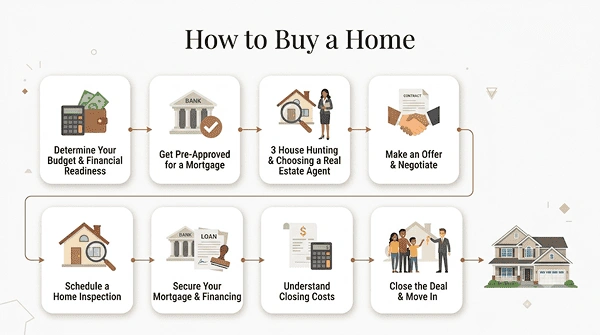
To understand how to buy a house, it is important to prepare for homeownership, which includes determining your lifestyle and budget, finding your desired home, closing the deal, and becoming the homeowner. These are some important phases of the home buying process, which involve multiple steps that you must be aware of:
Here’s how to buy a house if you’re a first-time buyer:
1. Determining the Budget and Financial Readiness
The first step of the home buying process is to determine whether you’re ready for a major financial decision and how much you can actually afford. Set up a realistic budget to avoid a financial burden and prepare yourself for the upfront and hidden costs of homeownership.
1. Calculating How Much You Can Afford
Estimate the maximum price you can afford based on your income, outstanding debt, and expected monthly mortgage payment. According to Redfin, a common way to estimate home affordability is by following a 28/36 rule. This recommends spending no more than 28% of your monthly income on house-related expenses.
These costs must include your mortgage, homeowners insurance, property taxes, and HOA fees (if applicable). You can use the US Bank affordability calculator to calculate how much you can afford.
2. Saving for Down Payment
A down payment is the upfront price that you must pay before buying a house. It generally costs 10% to 20% of the purchasing price. The larger your down payment, the lower your monthly mortgage payment.
Expert Recommendation:
Start saving early or maintain a dedicated savings account for this expense in the future. You can also earn interest on these savings.
You can also check the availability of the down payment program in your state for further assistance.
3. Plan for Additional Costs and Build an Emergency Fund
Closing costs and miscellaneous expenses make up a significant part of a budget when buying a home. Hence, besides the down payment and mortgage, keep the funds ready for:
- Closing Costs (appraisal, home inspection, homeowners insurance, legal fees, underwriting, etc)
- Moving expenses
- Initial Repairs and Maintenance
Keep at least 3 to 6 months of expenses as a contingency fund to avoid a sudden financial burden.
4. Check Your Credit Score and Gather Legal Documents
According to the US Bank, the minimum credit score required for most mortgages is 620. Check your credit score regularly, and if you have bad credit, review your credit history and start maximizing your score before house hunting.
Keep the important legal documents ready, such as pay stubs, tax information, assets and outstanding debts, W2 forms, additional income (rent, alimony, child welfare, etc).
2. Getting Pre-Approved For a Mortgage
Mortgage pre-approval is the process of checking the creditworthiness of the borrower. It is a written statement by the lender indicating the maximum loan amount you may qualify for based on your income, assets, credit score, and existing debts. The pre-approval letter is valid for 60-90 days and takes approximately 10 business days to arrive.
Important Note: It is not a final loan approval; rather, it ensures you a clear budget and indicates to the seller that you’re a potential buyer.
1. Documents Required For Getting a Pre-Approval
Here’s a checklist of all the documents required for getting a pre-approval during home buying process:
- Proof of Identity:
- Passport
- Driving License
- Social Security Card
- Proof of Income:
- Pay Stubs from at least the last 60 days
- Two Years of Tax Returns
- W2 or 1099 Forms
- Employer’s Contact Information
- Additional Income (Pension, Social Security, Alimony, Child Support)
- Existing Loan Statements:
- Credit Cards
- Student Loans
- Personal Loan
- Credit Report:
- Requires permission for the lender to check your credit score and profile.
- Proof of Assets:
- Savings and Brokerage Accounts
- Other real estate holding (if any)
- Retirement Accounts, such as IRAs and 401(k)s.
- Gift letters for down payment (if any)
- Self-Employment Documents (If You’re Self-Employed):
- Profit and Loss Statement for a Year
- Outstanding Invoices
- Business License and Insurance
- Business Bank Statements
2. Difference Between Pre-Approval and Pre-Qualification
Here’s how a pre-qualification is different from a pre-approval:
| Pre-Approval | Pre-Qualification |
|
|
3. House Hunting: Choosing the Right Real Estate Agent and Finding a Home
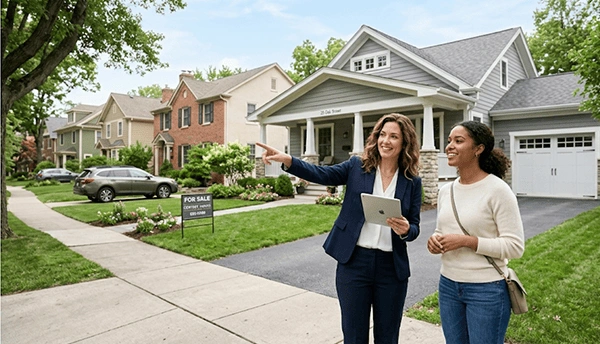
Once you know your budget, it’s time to hire a professional and experienced real estate agent with all the right information about the available homes. An experienced real estate agent will help you sort paperwork, spot the red flags, guide negotiations, schedule the house visits, and advocate for your best interests. Generally, the cost of hiring a real estate agent ranges between 4% and 6% of the purchase price.
1. How to Start House Hunting: Finding the Right Home
Step 1: Decide The Type of Home You Want
Your desired home can be an apartment, a standalone single-family house, a villa, a condo, or a townhouse. Identify the number of rooms and the space you require, keeping in consideration your current and future needs.
Important Tip:
Create a list of things that are non-negotiable, for instance, the number of rooms, amenities, and more.
Similarly, create a separate list for things you would like to have but are willing to compromise on. This ensures that you’ve a clear idea of what you want and what you don’t.
Step 2: Select the Right Location
Once you have an idea of your desired home, ensure that you select the right location, which has proper access to:
- Public Transportation
- Healthcare
- School
- Neighbourhood Safety
- Nearby Stores
Step 3: Searching for the Homes
Take the help of a real estate agent who can guide you about the available properties in your desired location. You can also look for new construction projects, open houses, or you may even look on online property portals.
Now, visit and evaluate the potential homes, keeping in mind your budget, lifestyle, and non-negotiable requirements. You should check:
- Structural Condition
- HVAC Installations
- Plumbing and Electrical Systems
- Future Maintenance
- Storage, Garage, and Basement Space
4. Make an Offer and Be Ready to Negotiate
Once you’ve found a home that suits your budget and lifestyle, make an offer to the seller. Keep the following things in mind:
- Firstly, with the help of your real estate agent, find out the ongoing property rates in that particular area to have an idea about prices, and finally decide the amount you want to quote.
- You can quote the price lower than what the seller has quoted. The seller may accept, reject, or make a counteroffer, leading to negotiations on the price, closing date, and other requirements.
5. Scheduling a Home Inspection
Hiring a professional home inspector helps in the professional evaluation of the property’s condition before you finalise the purchase. It helps identify the hidden issues, which may not be visible on the surface level during walkthroughs. This allows you to make informed decisions and negotiate the repairs before finally closing the deal.
According to the National Association of Realtors, the average cost of scheduling a home inspection is $400.
Here are some common issues that home inspectors look for:
- Structural Damages
- Roof Leaks and Damages
- HVAC Repairs
- Faulty Electrical Wiring and Plumbing Systems
- Pest or Termite Infestation
- Water Damage, Mold, or Dampness
Important Tip:
Let the seller know about the repairs required, if any, or negotiate the purchase price, allowing you to use the savings to complete the repairs yourself.
Take a final walkthrough of the entire house and ensure that the required repairs are made.
6. Secure Your Mortgage and Financing
After your offer is accepted and the home inspection is complete, get your finances secured. During this stage, you need to apply for homeowner’s insurance, get a home appraisal, and allow the lender to perform a final review of your finances and the property before approving and disbursing the loan. This phase can take 15-30 days.
Here are the steps that are performed during this stage:
- Final Loan Approval: The lender verifies your income, employment, assets, debts, credit history, and credit score. They also review the property’s value to ensure it meets the loan requirements.
- Property Appraisal: Ensure that a professional home appraisal is conducted to confirm that the home’s market value matches the purchase price. If the appraisal value is lower than the purchase price, then you may need to renegotiate the price or pay the difference.
- Review the Loan Offer and Complete the Documentation: Carefully check the loan amount, interest rate, monthly EMI, and other charges before accepting the offer. Submit the required documents and read all the terms and conditions carefully before signing the mortgage agreement.
- Loan Disbursement and Home Insurance: Once all conditions are met, the lender releases the loan, and you can proceed to closing. Apply for home insurance at this stage, which protects the home from natural disasters.
7. Understanding the Closing Costs
Closing costs are the one-time fees and expenses paid by both the buyer and the seller at the end of a real estate transaction. Generally, the closing costs range between 2% and 5% of the purchase price and are separate from the down payment.
The closing costs include:
- Loan Processing Fees: Also known as loan application, processing, or underwriting, these are charged by the lender to process your loan. It is 0.5-1% of the loan’s value.
- Third-Party Fees: It includes the appraisal fee, which is paid to a professional for estimating a home’s value, and home inspection fees, paid for a professional inspection to identify structural or safety issues.
It ranges from $ 200 to $ 500.
- Legal or Attorney Charges: Some states or locations might require a professional real estate attorney to close the deal. It is optional, and the price varies with the location.
- Lender and Owner’s Title Verification and Insurance: For the owner, it ensures that the property’s ownership is free of legal disputes. The lender’s title insurance protects the bank or mortgage lender if there’s a property dispute related to ownership, debts, or legal claims.
It is generally 0.5% to 1% of the purchase value for each.
- Homeowner’s Insurance: This insurance offers compensation in case of damage caused to the property due to natural disasters. The first premium may need to be paid at the closing and typically ranges from $50 per month.
- Property Taxes and Maintenance: Property taxes are levied by the government for public services. Generally, the lenders require you to pay at least a year’s worth of property taxes.
If your house is a condo or a townhouse, then it comes under HOA (Homeowners Association) and may require monthly or quarterly HOA fees.
- Mortgage Interest: Mortgage interest is also paid at the closing from the date of the closing to the end of the month.
Expert Recommendations:
To prepare for closing costs:
- Include these costs while determining the budget.
- Get an estimate from the lender early in the process.
- Keep aside contingency funds.
In some cases, closing costs can be negotiated. You can ask the seller to contribute and ensure reviewing the closing statement carefully to avoid duplicate charges.
8. Close the Deal and Move In

Finally, closing the deal is the last step in the process of buying a home. Sign the purchase agreement, pay the down payment and closing costs if not paid already. Once the formalities are over, you’ll receive the keys and become the legal owner of the property.
Closing the deal and moving in typically takes 30-60 days after the offer is accepted. During this stage, home inspection, appraisal, legal verification, and paperwork are completed.
1. Moving In
Moving in can be a hectic task; hence, hire professional movers for a smooth transition. It can cost somewhere between $800 and $2,500, depending on the home size and the distance.
Here’s what moving in requires:
- Setting Up Utilities:
It requires setting up essential services such as:
- Electricity
- Water
- Gas
- Internet
- Updating the Address in the Documents
Updating your address on the official documents is crucial. Hence, start applying for a change in:
- Banks
- Insurance Providers
- Government Agencies
Tips for First-Time Home Buyers and Common Mistakes to Avoid
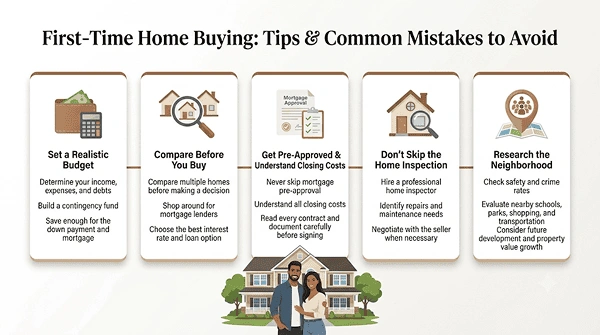
Here are some tips and common mistakes you must avoid during the process of buying a house if you’re a first-time buyer:
- Set a realistic budget by determining your income, expenses, and debts. Keep a contingency fund and save enough for a down payment and a mortgage.
- Do not rush into purchasing without comparing multiple properties and mortgage lenders to secure the best home and the best interest rate.
- Never skip the pre-approval and understand the closing costs. Read all the contracts and documents carefully before closing the deal.
- It is advised not to skip a professional home inspection and appraisal. Identify the repairs and maintenance needed and negotiate with the seller.
- Do not overlook the neighbourhood. Research its safety, amenities, and future growth.
Wrapping Up!
To sum up, the process of buying a house is significant and requires careful planning and informed decisions. Now that you know how to buy a house, you can navigate each stage with clarity. Understanding the home buying process is crucial, from budgeting to hiring a real estate agent, completing the paperwork, and finally closing the deal. Lastly, find a home that suits your current and future requirements as well as your budget.
Frequently Asked Questions (FAQs)
How much of a down payment do I need for a $3,00,000 home?
How long does the process of buying a house take?
Buying a home typically takes 3 to 6 months as it includes intensive paperwork, budgeting, mortgage pre-approval, home inspection, and multiple tasks before finally closing the deal.
Are home prices expected to rise or fall?
Home prices are expected to rise in 2026 as per the official sources, but it depends on multiple factors, such as inflation, demand, and the real estate market.
What credit score do I need to buy a house?
A minimum credit score of 620 is required to get your loan approved for most mortgages.
How to buy a house without a mortgage?
You can buy a home if you have enough funds to pay the full purchase price. It eliminates the need for loan approval, interest rates, and installments. However, you still need to pay registration fees, legal changes, and other closing costs.
Sources:
- Affordability calculator | How much house can I afford? | U.S. Bank: US Bank
- The Cost of Homeownership Continues to Rise: US Census Bureau
- Mortgage Prequalification vs. Preapproval – Understanding the Difference: Bank of America
Related Post

What is a Spec House? How to Buy, Cost Breakdown, ROI, Pros, Cons, and…
A Spec house, also known as a move-in ready house or an inventory house, is a residential property built by…
What is a Duplex? Definition, Cost, Types, and Pros & Cons
A duplex is made up of two separate living units on one shared piece of land. It combines the best…

Cape Cod Home: Cost, History, Types, Design, and Decor
Cape Cod home captures the cozy, nostalgic charm of America with its recognizable architectural style. This style of home originated…
How to Buy a House in 2026: Step-by-Step Guide and Tips to Follow
Wondering how to buy a house? The process involves multiple steps, from determining the budget to getting pre-approved, house hunting,…

Townhouse Vs Apartment: Key Differences Explained
Many people find it confusing to distinguish between a townhouse and an apartment, as they are both attached dwellings. But…

Townhouse Vs House: Key Differences, Cost Breakdown, Pros and Cons, and More
Townhouse Vs House: Which one is the better choice? The answer depends entirely on your budget, lifestyle, and long-term goals.…