
Townhouses often offer smaller living spaces with limited privacy due to shared walls and smaller yard areas. Moreover, the value of townhouses does not appreciate as much as single-family homes, and hence, they do not offer a great return on investment (ROI).
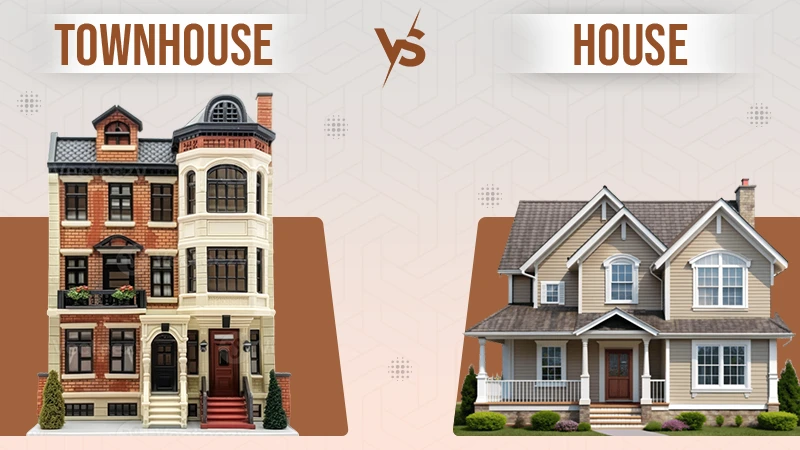
A townhouse is a multi-story home that shares a wall of one or more floors with another home, and a single-family dwelling resides on its own lot. Depending on budget and lifestyle, a townhouse might be a more affordable option and will require less exterior maintenance compared to a detached house, which will provide greater privacy, land, and flexibility.
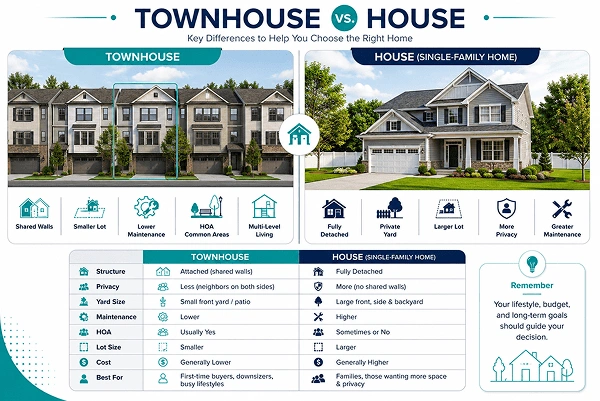
Townhouse Vs House: Which one is the better choice? The answer depends entirely on your budget, lifestyle, and long-term goals. While a townhouse ensures affordability, low-maintenance, and community-oriented living, a house provides more space, privacy, flexibility, and value appreciation. As both options offer the opportunity to build equity, the decision is crucial in today’s US house market.
According to Redfin’s analysis of the United States Housing Market & Prices, it is highlighted that home prices nationwide were up 2.0% year-over-year in May. At the same time, the number of homes sold rose 5.2%, with median home prices reaching up to $3,98,771. As the prices climb and the housing market becomes competitive, understanding the difference between townhouse and house can help you choose a property that fits your lifestyle and budget. This article compares the costs, ROI, resale values, pros, and cons that will help you make an informed decision. Before choosing between a townhouse and a detached house, our architectural design team can help you evaluate the right layout based on space, privacy, budget, and future needs.
Table of Contents:
- What is a Townhouse? Key Features of a Townhouse
- What is a House? Overview and Essential Characteristics
- Townhouse Vs House: A Comparison Table
- Complete Cost Breakdown of Buying a Townhouse and a House
- Pros and Cons of Owning a Townhouse Vs House
- Market Considerations and ROI: Which Investment Option Offers Better Returns in 2026?
- Townhouse Vs House: Which One Suits Your Budget and Lifestyle
- Wrapping Up!
- Frequently Asked Questions (FAQs)
What is a Townhouse? Key Features of a Townhouse
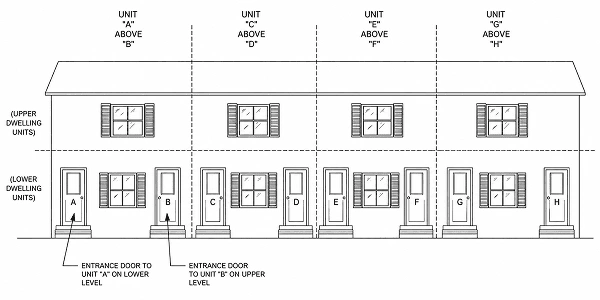
The International Code Council defines a townhouse as a “single-family dwelling unit constructed in a group of three or more attached units in which each unit extends from foundation to roof and with a yard or public way on at least two sides”.
In simple words, a townhouse is a multi-story attached home that shares at least one common wall with the neighbouring unit, has its own entrance, and usually includes the ownership of the land beneath it.
Here are common features of a townhouse:
- Multi-Story Layout
- Shared Side Walls
- Private Entrance
- Individual Ownership
- Modern Amenities
- HOA Maintenance
- Compact Outdoor Space
What is a House? Overview and Essential Characteristics
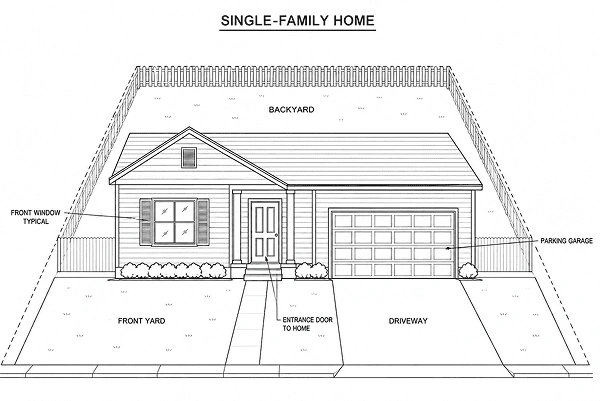
A house is a standalone residential unit designed for one household. It provides a private indoor and outdoor living space, and the owner typically owns both the home and the land it sits on. Unlike attached homes, it does not share walls with neighbouring properties.
However, according to the US Census Bureau, single-family structures include fully detached, semi-detached (semi-attached, side-by-side), row houses, duplexes, quadruplexes, and townhouses. They can be classified as a single-family structure if they:
- Have a separate heating structure
- Separate meters for public utilities
- Separated by a ground-to-roof wall
- Have no units located above or below
Townhouse Vs House: A Comparison Table
While a townhouse is an attached multi-level home that shares walls with neighbours and includes common areas and shared amenities, a single-family house functions as a standalone unit with its own lot. However, a townhouse and a house differ in terms of ownership, maintenance, location, amenities, and cost.
Here are some differences between a townhouse vs house you must know:
| S No. | Features | Townhouse | House |
| 1. | Structure | These are attached multi-level homes that share one or two walls with neighbours. | A single-family home is a standalone residential unit that stands on its own lot with no shared walls with neighbours. |
| 2. | Cost and Ownership | Less costly than single-family homes, townhouses typically allow owners to own the land beneath their unit, while common areas are shared. | Higher upfront purchase price, and homeowners own both the land and the house. |
| 3. | Maintenance | The Homeowners Association (HOA) is responsible for the maintenance of outdoor areas. | The homeowners are solely responsible for all the repairs and maintenance. |
| 4. | Location | Townhouses are located in urban areas, closer to city conveniences. | Single-family homes are located in suburban areas, usually in spacious neighbourhoods. |
| 5. | HOA Fees | Monthly or quarterly HOA fees are mandatory and required for maintenance and upkeep. | No HOA fees. |
| 6. | Amenities | Shared amenities, such as parks, pools, and gyms, are common. | Shared amenities are less common. |
| 7. | Ideal For | First-time buyers and people seeking low-maintenance living. | Single Families, multi-generational living, seeking more space, comfort, privacy, and flexibility. |
Complete Cost Breakdown of Buying a Townhouse and a House
Buying a townhouse is more affordable than buying a single-family house. The complete cost breakdown includes various surface-level charges, such as property and insurance taxes, down payment and mortgage, as well as hidden charges, such as moving costs, cash reserve, inspection fee, and more.
Here’s a complete cost breakdown that will help you in budget planning:
Cost Breakdown of Buying a Townhouse
Redfin’s data highlights that the median cost of buying a townhouse is $3,65,000.
Here’s a complete cost breakdown of buying a townhouse:
| Expenses | Average Cost |
| Down Payment | 3-15% of the purchase price |
| HOA Fees | $200 – $300, monthly or quarterly |
| Closing Cost | 2-5% of the purchase price |
| Property Tax and Insurance | 1-2% of the property’s value |
Cost Breakdown of Buying a Single-Family House
According to a recent report called MONTHLY NEW RESIDENTIAL SALES, MAY 2026 by the US Census Bureau, the median sales price of new homes is $4,24,900, which is 2% above the median sales price in April 2026.
Here’s a complete cost breakdown of the things you need to consider while budget planning:
| Expense | Average Cost |
| Down Payment | 15-20% of the purchase price Example: If you buy a house for $4,24,900, then the down payment will be $4,24,900*15% = $63,735 |
| Closing Costs | 2-5% of the purchase price |
| Inspection Fee | $300 – $600 |
| Appraisal Fee | $300 – $700 It depends on the size and location of the property. |
| Cash Reserve | Approx Two Months of Mortgage Payments |
| Moving Out Cost | $800 – $1,200 |
| Property Taxes | 1-2% of the home’s value per year |
| Homeowner’s Insurance | $1,500-$3,000 per year |
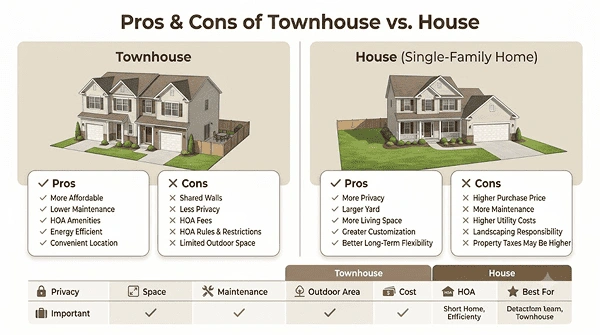
Pros and Cons of Owning a Townhouse Vs House
1. Pros and Cons of Owning a Townhouse
Here are some pros and cons of buying a townhouse:
| S No. | Pros of Buying a Townhouse | Cons of Buying a Townhouse |
| 1. | Townhomes are 16-17% less expensive than single-family homes. | The lot sizes of townhouses are limited, which reduces the chances of landscaping and customizing your space. |
| 2. | Homeowners often get access to common spaces and shared amenities, such as swimming pools, playgrounds, and community gyms. | The value appreciation of townhouses is generally lower than that of single-family homes. |
| 3. | Townhouses often lack large exterior spaces, and even if they have, exterior spaces are generally maintained by the HOA, making it a low-maintenance living. | It requires monthly and quarterly HOA fees, which may increase over time. |
| 4. | It requires less upkeep and offers a secure living experience. |
2. Pros and Cons of Buying a House
Here are the pros and cons you must consider before buying a house:
| S No. | Pros of Buying a House | Cons of Buying a House |
| 1. | Single-family homes offer greater value appreciation than buying a condo or a townhouse. | It lacks shared amenities, such as pools, gyms, and playgrounds. |
| 2. | It offers greater autonomy over the property and more space and freedom for customization and landscaping. | The upfront purchase price of a single-family home is higher than that of a townhouse. |
| 3. | A single-family home offers greater privacy, as they are generally located in spacious neighbourhoods, where houses are distant from each other. | The responsibility of maintenance lies solely with the homeowners, which can be expensive. |
| 4. | There is no mandatory HOA or maintenance fee. |
Market Considerations and ROI: Which Investment Option Offers Better Returns in 2026?
While traditionally, buying a single-family house is considered the best investment with greater ROI and future value, as the affordability pressure heightens, townhomes may take over single-family homes in the coming years. According to Realtor.Com, single-family homes appreciated 87.3% from 2014 to 2024, and townhouses nearly matched the pace at 86.5%. The modest gap highlights the growing role of townhomes in the US housing market.
Townhouse ROI: Is It a Good Investment?
According to the National Association of Home Builders, townhouse construction is expanding more than 9% on a year-over-year basis, per data from the second quarter of 2025.
The primary reason for the steady growth of townhouses is their home-like living, ownership of both the land and the residential unit, and affordability as compared to single-family houses. Hence, it can be said that townhouses will offer a competitive ROI in the coming years, because of the land value appreciation.
Buying a Townhouse is a great investment option if and only if:
- It offers a lower purchase price
- Located in high-demand urban and suburban areas
- Lower maintenance cost
- Offers the best community services and amenities
Important Note:
With all being said, townhouses may NOT generate rental income due to HOA restrictions, and may face slower value appreciation because the land under a townhouse is often less than a single-family house.
House ROI: Is It a Good Investment?
Buying a house is one of the best financial decisions that yields higher ROI and future value. According to the US Federal Housing, US house prices increased by 1.7 percent from February 2025 to February 2026, which shows a greater annual appreciation rate for houses.
This steady appreciation rate enables the homeowners to build wealth through increasing property values, as well as potential rental income.
Buying a house is the best investment option if:
- Homeowners plan for a long-term stay
- Generates a rental income
- Retains and appreciates value, especially during inflation.
Reddit Query: First-time home buyer – townhouse vs single-family? Concerned about appreciation & job risk

Buying a townhouse is one of the best options for first-time home buyers and people under job risks, simply because:
- It is low-maintenance, generally maintained by the HOA.
- Townhouses offer access to community services and modern amenities, such as pools, playgrounds, and gyms.
- The upfront purchase price of a townhouse is significantly lower than that of a single-family house.
- Lower mortgage and down payment.
- It projects a steady appreciation rate in the coming years.
Townhouse Vs House: Which One Suits Your Budget and Lifestyle
Which one is better- townhouse vs house depends entirely on the buyer’s budget. A home can be a perfect choice for people seeking a long-term stay and a growing family, while townhouses are a great option for busy professionals seeking an affordable and low-maintenance stay.
Choose a Townhouse If You Value Low-Maintenance and Affordability
A townhouse is a perfect option for people seeking affordable homes without sacrificing comfort. It typically costs less than buying a single-family house and requires less exterior maintenance, as most of the responsibilities are handled by the Homeowners Association (HOA).
Choose a Townhouse if you:
- Are a First-Time Home Buyer
- Seek Affordability and Low Maintenance
- Like Community Amenities, including Gyms, Parks, and Pools
- Don’t Require Large Yard or Extensive Outdoor Space
Choose a House If You Value Space and Long-Term Flexibility
A single-family house is a better option if you want more living space, greater privacy, and complete ownership of both the house and the land. Unlike townhouses, a single-family detached home offers more space and flexibility to renovate, remodel, and customize the space as per your preference. While they typically cost more, they offer stronger long-term value and appreciation.
Choose a House If You:
- Have a Growing Family and Need Extra Space
- Value Privacy and Large Outdoor Space
- Want the Freedom to Renovate or Expand Your Home
- Planning For a Long-Term Stay
- Intend to Generate Rental Income or Gain Resale Value
Wrapping Up!
To sum up, house vs townhouse: both are both great options, but the choice of buying a house or a townhouse depends entirely on the buyer’s budget and lifestyle. For the affordable and low-maintenance stays, a townhouse is one of the best options, and for more freedom, privacy, and space, a single-family home is a perfect choice,
However, it is essential to consider the hidden costs and factors that may affect the budget planning. Therefore, buying real estate can be a significant milestone, but with proper budget planning, it gives the best future value.
Frequently Asked Questions (FAQs)
What are the disadvantages of buying a townhouse?
Is it better to buy a townhouse or a house?
The choice between a townhouse and a house depends entirely on budget and lifestyle. However, buying a house is a better option in terms of return on investment, value appreciation, autonomy, privacy, and customization.
Why are townhouses cheaper than single-family homes?
Townhouses are comparatively cheaper because of their smaller land size, shared walls, which reduce the construction costs, lower maintenance responsibilities, and less outdoor space.
Do townhomes hold value?
Yes, townhouses significantly hold value as their appreciation rates have been growing higher over the years. Although their value appreciation is lower than that of a single-family house, it yields a great future resale value.
What is the difference between townhouse and house?
The difference between townhouse vs single family home is that while a house is a separate residential unit that does not share walls with neighbours and include the ownership of the land, a townhouse is an attached unit that comes with modern amenities, and is maintained by HOA.
Sources:
- Median Home Price By State: How Much Do Houses Cost? : Forbes
- Townhouse Construction Hits Record Market Share | NAHB: National Association of Home Builders
Related Post
Sunroom Addition: Ideas, Cost & Design Guide
Want to add extra space in your home? With having the feel of openness and brightness, a sunroom addition is…
A complete guide to transom windows – know what it is
Have you seen a small window just above the door? This is not only for decoration; it is a transom…
Ideas, Types, Benefits & Complete Guide of Outdoor Fireplace
If you want your backyard, patio, or outdoor living area to be comfortable and livable, then an outdoor fireplace is…

Latest Home Decor Trends to Follow in 2026 for a Stylish Home
The way you design your home reflects your entire personality; hence, it is necessary for your interior to speak your…

Exterior Painting Cost in 2026: A Guide to Getting the Best Painting Prices
Planning to give your home a fresh look with a coat of paint? Not only color, but painting a house…

How Much Does it Cost to Remodel a Bathroom? Average Estimate, Cost Breakdown, and…
Bathroom remodeling can give your home a fresh look and improve its resale value concurrently. However, the entire process needs…