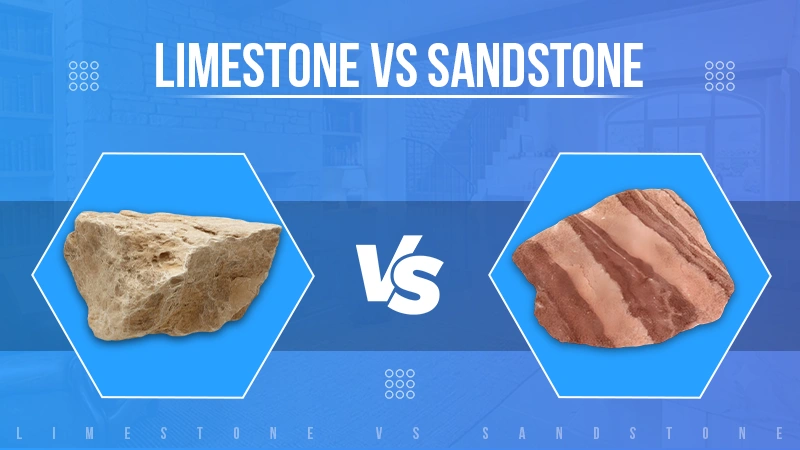
Limestone and Sandstone are sedimentary stones, and limestone is smoother and more even in neutral colours; sandstone has a more prominent grain and colour. Typically, limestone is used in stylish facade applications and sandstone in warm-tone exterior applications (climate and maintenance requirements determine use).
Exploring the difference between limestone vs sandstone is key when you need to find out which stone is better. Sandstone might give you variety, but limestone boasts better durability without high upkeep! Thus, while selecting, such nuances matter a lot. That is why you shouldn’t pick any material without deep research. Always study how they differ and then make your order. The following sections make out a clear distinction between both these options in the category of building stones.
Limestone is a type of sedimentary rock. It is formed out of the remnants of marine animals.It has a smooth texture and uniform appearance from a distance. That makes it an ideal choice in a variety of residential settings. You will typically find it in subtle and neutral tones. Major colors are grey, beige, and blue.
Further, before exploring differences between limestone vs sandstone, let’s go through key characteristics of limestone in the table below.
Key Characteristics
Appearance: Smoother, less bumpy, & more refined
Durability: Pretty durable and weather-proof; could be an ideal choice for outdoor living areas
Color palette: Typically neutral and modern tones
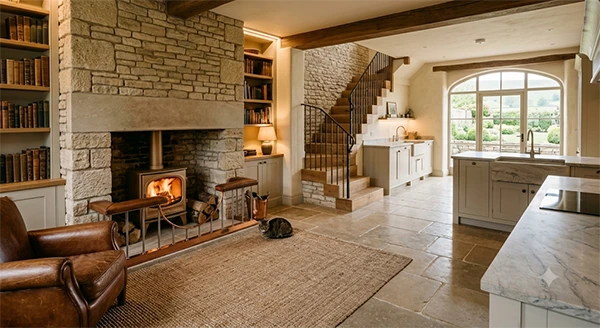
It is often preferred to build walkways or outdoor floors under a porch or any other outdoor living spaces. You will find it in several types of houses, including thespec house.
Beware: If there is a property entirely built on limestone ground and you want to buy it, make sure you consult an expert before investing. JB_Market says that limestone is water-soluble. And, therefore, there might be a sinkhole that can swallow the house in the worst-case scenario. Refer to the screenshot below.
Sandstone is another component of the limestone vs sandstone query. Thus, exploring this particular and another form of sedimentary rock separately will be helpful too. This stone is made up of sand and mineral particles. It takes years of compression under the earth for such compact structures to form. This stone mainly contains quartz or feldspar, which are highly wear-resistant.
Do you know? Sandstone is found in large deposits in the United States, Germany, and South Africa.
Key Characteristics
Appearance: Coarser surface and more varieties available in tone and texture
Durability: Tough and less porous than limestone
Color palette: Multiple hues or shades of warm reds, browns, greys, and yellows available
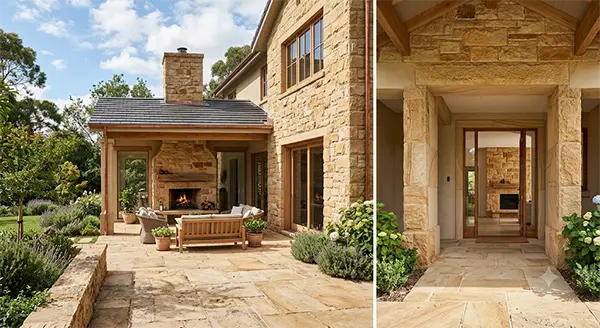
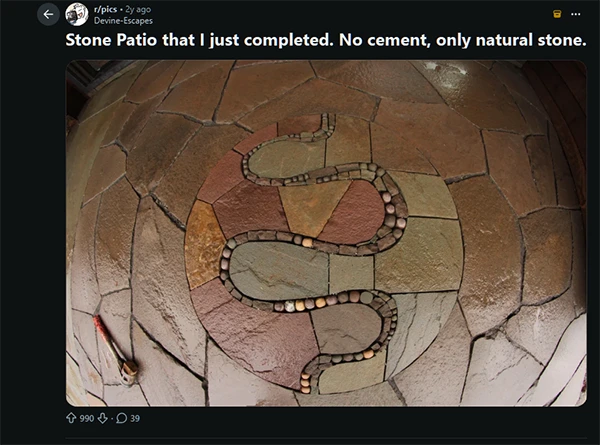
Sandstone walkways or flooring is very common in duplexes, both to accentuate the curb appeal and to complement garden spaces. You can also be creative with this variety of stone, like Devine-Escapes, a Reddit user. Refer to the screenshot below.
Thus, this stone can be a great tool in the hands of DIY enthusiasts.
Limestone vs Sandstone: A Quick Comparison Table
The difference between limestone and sandstone is mainly that of composition and color varieties. That is because both are sedimentary rocks and highly durable. The following table highlights key differences based on formation, composition, cost, durability, application, versatility, and maintenance.
Features
Limestone
Sandstone
Formation
From organic remains
From sand-sized particles
Composition
Calcium carbonate
Quartz or feldspar
Cost
Affordable
Depends on availability and source
Durability
Very high
High
Application
Countertops, fireplaces, and weather-exposed places
Facades, landscaping, and cladding
Versatility
Major colors are grey, beige, and blue
Multiple hues or shades of warm reds, browns, greys, and yellows
Maintenance
Low
Regular cleaning and sealing
Handy advice: Choose limestone for any rough, weather-exposed area outside your property or for garden aesthetics. But if you want more variety in colors, sandstone is what you might want to consider.
Is Limestone Expensive?
Theaverage cost of limestone is $70 to $200 per square foot. So, whether it is expensive or affordable entirely depends on your budget, a subjective factor. However, if you want something below this range, consider the following table.
Stone
Cost per square foot
Limestone
$70 to $200
Granite
$40 to $60
Quartz
$50 to $65
Marble
$75 to $250
Sandstone
$5 to $10
So, is limestone expensive? It is indeed expensive, as compared to granite, quartz, and sandstone, but not marble.
When to Choose Limestone?
Consider when you should choose limestone based on class I to III in the table below. There are three categories in limestone, namely, class I, class II, and class III.
Class Type
When to Choose
Class I (Light Duty)
Best for dimensional pieces and carving
Class II (Medium Duty)
Best for thin cladding, bath applications, and residential flooring
Class III (Heavy Duty)
Marble-like limestones best for countertops or places with heavy commercial traffic
If you want to explore a modern-day building example that uses these limestone categories most pragmatically, consider Le Louvre. In this structure, the original building was built using soft limestone. That is class I, and it allows beautiful carving.
Next, the interior part, a recent extension, boasts fine work of a medium-duty stone. And the flooring of this new interior is equipped with class III heavy-duty limestone. That makes the floor capable of withstanding the foot traffic of more than 7.5 million people each year.
Do you know? If you have knowledge and understanding, you can create fabulous structures out of limestone. That is because it is durable, sustainable, and controls temperature and humidity better. It is easy to clean and maintain as well. This knowledge is also crucial after considering the difference between sandstone and limestone.
Note:If you are self-building an ADU or Accessory Dwelling Unit inside the premises of your primary house, make sure you choose limestone for landscaping. It is rough, tough, and weather-resistant.
You should definitely pick sandstone if you need to take advantage of its features and benefits. The following explains its natural beauty, slip resistance, eco-friendliness, versatility, comfort, and more.
Natural beauty: You will get unique yet beautiful veining and patterns in the composition of this stone. It will provide a warm, earthy look to your place after installation. Such hues look great in outdoor garden areas.
Slip-resistance: If you are looking for something for your bathrooms or outdoor patios, this is the ideal choice. That is because every time the floor is wet, you don’t have to worry about slipping and knocking yourself down! You will always have the full grip, no matter how wet it is!
Eco-friendliness: It is not made out of any artificial or harmful material. There is no plastic involved as well. Sandstone is totally natural and blends well with most vegetative spaces outside residential as well as commercial properties.
Versatility: Sandstone can be used in almost all types of flooring in outdoor spaces. In short, it works well in all types of rustic, Mediterranean, and modern-style homes.
Comfort: You get natural warmth underfoot. That makes it the most ideal choice for garden walkways.
So, you should choose sandstone when you need all these benefits. However, it has some cons too that you must consider. These are as listed below.
Regular sealing: It requires regular sealing every 6 to 12 months. That is because sandstone is porous and absorbs moisture. So, sealing is essential for longevity.
Using a pH-Neutral Cleaner: That is essential to prevent the stone from eroding. Acidic cleaners erode the sandstone and leave it vulnerable to severe damage from the elements.
Wiping spills or adhesive materials quickly: It is an essential practice if you want to keep your stone work clean.
Note:For cleaning, always use the soft brush. It will help remove the dirt without scratching or damaging the surface.
Insight:This information must have helped further clarify key differences between sandstone vs limestone and also which one you should choose.
Limestone vs Sandstone: Sealing and Maintenance
From a sealing and maintenance perspective, let’s also consider limestone vs sandstone. Sandstone requires more maintenance than limestone.
Limestone: It requires low maintenance. And you can clean it as and when required. Furthermore, you don’t have to apply any sort of sealant as well. It is highly strong and weather-resistant.
Sandstone: This stone requires periodic cleaning and sealing every 6 to 12 months. So, you might have to spend money on maintenance as well. And it can get expensive, given the vastness of the space that features this stone.
How to decide:If maintenance isn’t an issue and you need variety in color, you should definitely select any type of sandstone you love!
While exploring the difference between limestone vs sandstone, we have understood that both fall in the category of sedimentary rock. And, selecting which one you should choose entirely depends on your budget and needs. However, if you choose sandstone, you will have to pay extra for periodic sealing-related practices. And, if you select limestone, that is more expensive than the former.
FAQs
Q. Which is better, limestone or sandstone?
Limestone is better if you need less maintenance hassle and a more rustic feel for walkways or porch floors. However, sandstone is affordable and comes in a variety of colors and hues, as compared to the former.
Q. Is limestone the same thing as sandstone?
No, they are two different types of sedimentary rocks. They look different and come in distinct shades of color. Furthermore, you will find that their costs are dissimilar too. Moreover, they are composed of separate materials from a technical perspective!
Q. Is sandstone weaker than limestone?
Yes, limestone is stronger than sandstone. That is why if you apply sandstone, you have to pay extra periodically for sealing. Otherwise, moisture will erode the stonework over time.