
Ans. While a house offers complete autonomy over the indoor and outdoor space, plot, land, and yard, a condo shares boundaries with neighbours and offers autonomy only over an individual unit, with common areas jointly owned.

A condo means that you have ownership of one unit but shared areas are managed by the condo association, while a house means that you own the building and the land it is on. Condos are typically less expensive to maintain, have shared amenities, and more privacy than houses; houses have more control and space, and it is the deciding factor in HOA costs.

Buying a condo vs house comes with its own set of advantages and disadvantages. A condo may be a great option with a lower purchase price, less maintenance, and access to shared amenities, ideal for first-time buyers. According to the US Census Bureau, approximately 21.6 million U.S. households paid either a condo or HOA fee in 2024, highlighting how condo living has become popular.
Similarly, a house offers a better living space, privacy, and land ownership, ideal for growing families and long-term homeowners. Redfin’s analysis highlights that U.S. home prices were up 2.0% in 2026, reflecting the demand for traditional homeownership. Whether you’re prioritizing affordability, lifestyle, or investment potential, this article will help you understand the key differences between buying a condo vs house, pros and cons, ROI, and cost. Follow along to know more:
Whichever property type you choose, our interior design team can help you maximize the available space and create a functional layout suited to your lifestyle.
Table of Contents:
- Condo Vs House: Key Differences Explained
- Cost Breakdown for Condo and House: Which is More Affordable?
- Pros and Cons of Condo Vs House You Must Consider Before Investing
- Condo Vs House: Which Investment Offers Better Returns in 2026?
- Condo Vs House: Which is Better for Your Budget and Lifestyle?
- Wrapping Up!
- Frequently Asked Questions
Condo Vs House: Key Differences Explained
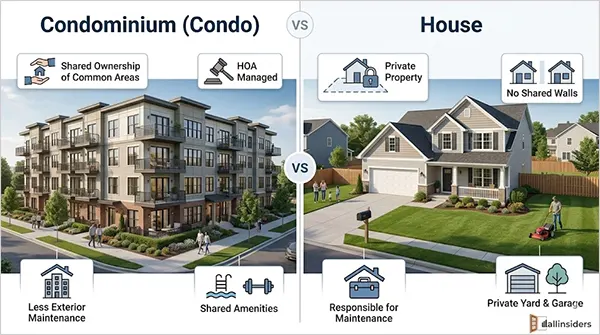
While a house offers complete autonomy over the indoor and outdoor space, plot, land, and yard, a condo offers autonomy only over an individual unit, with common areas jointly owned. Hence, a condo and a house differ in ownership status, maintenance, rental, resale value, purchase price, and more.
Here are some differences between a condo and a single-family home at a glance:
| S No. | Key Difference | Condo | House |
| 1. | Ownership and Community | Allows autonomy over an individual unit, and common areas, such as elevators, hallways, and lobbies, are shared with other owners. | Offers complete autonomy over the property and decisions regarding remodelling and landscaping, regarding zoning laws. |
| 2. | Maintenance | Interior is maintained by homeowners, whereas shared spaces and exterior are typically maintained by the Condo Board or Homeowners Association (HOA). | The homeowner is responsible for external and internal maintenance. |
| 3. | Land Ownership | No individual land ownership, and common areas are owned jointly. | Includes the lot, yard, and outdoor space. |
| 4. | Purchase Price | A condo has a lower upfront purchase price, but it requires you to pay monthly or quarterly HOA fees for maintenance and amenities, which may increase over time. | Buying an entire house can be more expensive than buying a condo. However, it’s best to avoid monthly HOA fees. |
| 5. | Resale Value | The resale value of a condo generally depends on the market value, condition of the shared spaces, and the financial health of the HOA. | Better resale value, especially in desired neighbourhoods, and significantly increases over time. |
| 6. | Rental Potential and Privacy | Limited privacy due to shared common areas and limited or no rental potential, as it is restricted by HOA rules and rental caps. | Greater privacy with personal outdoor spaces, and offers greater flexibility to rent out the property. |
| 7. | Suitability | Ideal for people seeking low-maintenance homes, first-time buyers, and professional workers. | Ideal for families, multi-generational living, seeking more space, comfort, privacy, and flexibility. |
Cost Breakdown for Condo and House: Which is More Affordable?
While condos can have a lower upfront purchase price, houses are best for long-term appreciation potential and wealth building. However, before investing, it is important to consider certain factors, such as insurance, maintenance, mortgage cost, property taxes, ownership costs, and more.
Here’s a complete cost breakdown, which will help you decide which options suit you better:
| S No. | Features | Condo | House |
| 1. | Upfront Purchase Price | The National Association of Realtors highlights that the median price of a condo in 2025 was $3,78,200. | According to the US Census Bureau, the median sales price of new houses sold in May 2026 is $4,24,900. |
| 2. | HOA or Condo Fees | Ranges typically from $300-$1500. It includes maintenance of:
| None |
| 3. | Maintenance Fees | Usually covered in the HOA fees | The average maintenance cost per year can be $4,000-$22,000. |
| 4. | Property Tax and Insurance | $572 per year, on average | $2,490-$2,720 |
Pros and Cons of Condo Vs House You Must Consider Before Investing
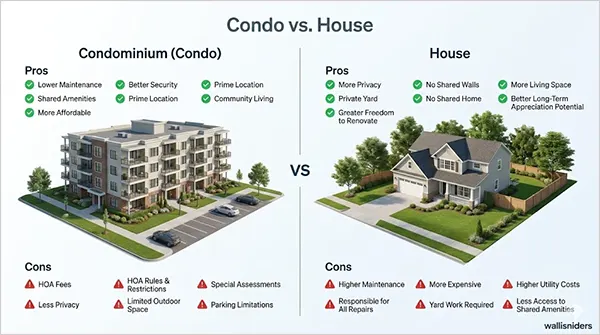
While a house ensures greater privacy, autonomy, and value appreciation, a condo may offer better amenities, maintenance, and cost-efficiency. But there are certain things, such as ROI and rental value in the long term, that one must consider before investing in a house or a condo.
Here are the pros and cons of a condo vs house:
Pros and Cons of Buying a House
Here are some pros and cons of a house you must consider before investing:
| S No. | Pros of a House | Cons of a House |
| 1. | It offers greater control and autonomy over space. Homeowners own the plot and yard and have complete flexibility to remodel the space. | A single-family house may require maintenance over time, and homeowners are solely responsible for it. |
| 2. | Since there are no shared walls with the neighbours and no jointly owned areas, a single-family home ensures greater privacy. | Buying a house is generally more expensive than buying a condo. |
| 3. | House values appreciate more, and they offer a great Return on Investment (ROI). | Usually, houses are not located in the busy city centers; hence, access to amenities, such as a pool, gym, and more, can be limited. |
| 4. | No mandatory HOA or maintenance fees. |
Pros and Cons of Buying a Condo
| S No. | Pros of Buying a Condo | Cons of Buying a Condo |
| 1. | Buying a condo and its home insurance is generally cheaper than buying a house, which is ideal for first-time buyers. | Although buying a condo is less expensive initially, it requires monthly or quarterly HOA fees, which may increase over time. |
| 2. | The owners are not responsible for maintenance. Rather, a condo board or homeowner association takes care of the outdoor and shared spaces maintenance. | A condo may not offer greater privacy due to shared walls and jointly shared space. |
| 3. | Condos offer convenient amenities, such as a pool, playground, gyms, and security. | It might not be a great investment option when compared to a house, as there can be restrictions on rental. |
| 4. | It ensures minimal upkeep and a secure living experience. |
Condo Vs House: Which Investment Offers Better Returns in 2026?
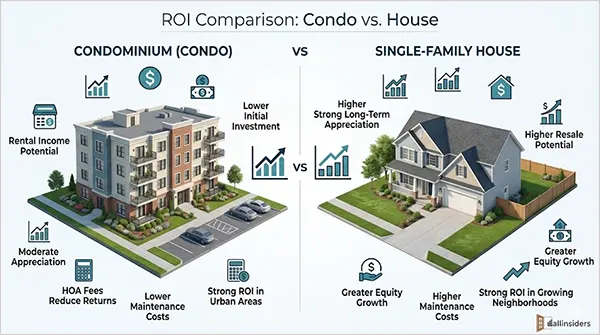
Buying a house is one of the best investment options in 2026, compared to purchasing a condo, simply because of its constant value appreciation and higher potential for rental income. According to the US Federal Housing, nationally, the US House Prices Rise 1.8 Percent Year over Year, which highlights the long-term wealth-building potential for homeowners.
Here’s everything you need to know about the ROI of a condo and a house:
How Buying a Home Can Be a Smart Investment Option?
Buying a house is one of the best investment decisions for people looking to build long-term wealth, gain stability in housing costs, and benefit from the property appreciation rates over time. They are best for:
- Single Families
- Multi-Generational Living
- Renting
- Wealth Builder and Investors
ROI Considerations While Buying a House: According to the US Federal Housing, US house prices increased by 1.7 percent from February 2025 to February 2026, which shows a greater annual appreciation rate for houses. Hence, purchasing a house in 2026 can offer a greater return on investment in the future than buying a condominium.
Here’s how buying a home can create value over time:
- Real estate often retains and appreciates in value during inflation periods, and hence, rent also appreciates in value.
- Offers a high rental income.
- Equity is built through monthly mortgage payments and increasing ownership.
How Buying a Condo Can Be a Smart Investment Option?
Buying a condo can be a smart investment option for first-time homebuyers, busy professionals, aging people, and someone who’s seeking little maintenance hectic. The upfront cost of a condo is less than that of a house, and hence, it is perfect for people entering the real estate.
ROI Considerations While Buying a Condo: Redfin News highlighted the risk of condos losing value, showing that one in 10 condos is at risk of being sold at a lower value, and the investor purchases of U.S. condos dropped 13%, year over year, in the second quarter–the biggest drop in two years. Hence, buying a condo may not be the safest option anymore.
Here’s how buying a condo can create value over time:
- The entry cost for a condo is more affordable than that of a single-family home.
- Condos may significantly increase value in high-demand locations.
- Since it has low-maintenance living, it may attract potential buyers.
- Access to amenities may increase its value over time.
Important Note:
An appreciation in a condo’s value depends on various factors, such as maintenance, neighbourhood, amenities, and upkeep of the condominium property.
Condo Vs House: Which is Better for Your Budget and Lifestyle?
Which one is better, buying condo vs house, depends entirely on the buyer’s budget and lifestyle choices. While a condo may be a better option for people seeking affordable stays with low maintenance requirements, a house can be an ideal choice for greater privacy, long-term flexibility, and more living space.
Here’s what you need to know before selecting condo vs single-family home, and which one suits your budget and lifestyle better:
Choose a Home If You Value Space, Rental Income, and Independence
A house is often a better choice for people seeking more room, comfort, and greater control over their property. Unlike condos, houses include land ownership and also offer private outdoor and indoor space with fewer restrictions from laws and boards.
Consider buying a house if you:
- Have a Growing Family
- Desire to Earn Rental Income
- Seeking Privacy and Independence
- Planning to Stay Long-Term
Choose a Condo If You Value Affordability and Convenience
A condo is a suitable option for individuals seeking affordability and low maintenance requirements. This is a perfect option for first-time buyers and young professionals, as the maintenance and common area upkeep is generally maintained by the Homeowners Association (HOA).
Consider buying a condo if:
- You are a Frequent Traveller
- Want to Access Amenities, such as Pools, Gyms, and Playgrounds
- Prefer Low-Maintenance Living
- First-Time Homebuyer
Wrapping Up!
To sum up, both the condo and house have their own advantages and disadvantages, but this article will definitely help you choose a better option that matches your lifestyle and budget.
A condo is a perfect option for first-time buyers, while those seeking a long-term stay and better investment opportunity, buying a house is one of the best options.
Frequently Asked Questions
Q1. What is the difference, house vs condo?
Q2. Can you permanently live in a condo?
Ans. Yes, you can live in a condo permanently when you own an individual unit. It’s like a traditional home, but it is managed within the community.
Q3. Why do people choose condos over houses?
Ans. Condos are widely chosen because they ensure affordability for first-time buyers. These are generally low-maintenance and offer some of the best amenities, including gyms, pools, and playgrounds, which might not be available in a single-family home.
Q4. What is the downside of a condo?
Ans. Restrictions by homeowners association, lower ROI, privacy, and ever-increasing HOA fees are some of the downsides of a condo that a potential buyer must consider before investing.
Q5. Where can I live for $500 a month in the USA?
Ans. Shared housing in affordable metro cities is the only possible way to live for $500 per month in the USA.
Related Post

Single Family Home: Cost Breakdown, Differences, Pros, and Cons, and More
A single-family home is any house that is constructed on a separate lot from other houses for one family, and…
Condo Vs House: Key Differences, Costs, Pros and Cons
A condo means that you have ownership of one unit but shared areas are managed by the condo association, while…

The Condo vs Coop Analysis with Ownership Structures, Governance & Rules, Amenities, Costs &…
A condo is one unit in a condo complex which you own outright; with a co-op, you are a shareholder…

What is an ADU (Accessory Dwelling Unit)? Benefits, How to Construct, Cost Breakdown, and…
An ADU is a small, separate home attached to a main house, which can share a driveway but has its…