
A good size for a master bedroom is 200 to 350 square feet. However, many residential properties also boast a standard size of 224 square feet.
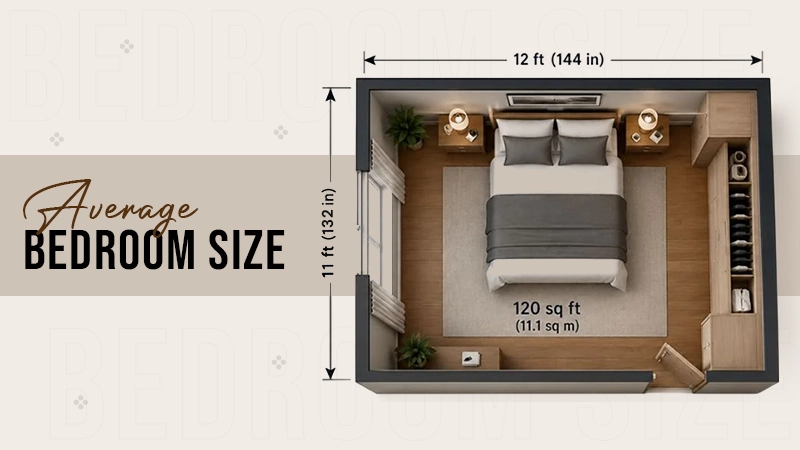
Bedroom sizes in the U.S. average 132 square feet, which is roughly 11 x 12 feet, although it varies depending on the type of bedroom, with master bedrooms averaging 200 to 250 sq ft, and guest rooms averaging 100 to 120 sq ft. The typical local building code requires a minimum of 70 square feet.
Compliance with the average bedroom size as per the applicable law matters a lot when it comes to a residential property’s appraisal during sale. If you own a house, the bedroom in it has to be of a specific size to fit the needs of a human being legitimately. Otherwise, the space cannot be listed as a valid bedroom, and that will lower the home value dramatically. Minimally, a legally compliant bedroom at least has to be 70 square feet and not less than that. There are other conditions as well that you will find below in this article.
Table of Contents:
- What is the Average Bedroom Size?
- Standard Bedroom Sizes by Room Type
- Minimum Legal & Building Code Bedroom Sizes
- How Bedroom Size Affects Home Value
- Average Bedroom Size by Country
- How to Know If Your Bedroom is Standard Size
- What Fits in a Standard-Size Bedroom?
- Small Bedroom vs. Average vs. Large: Pros, Cons, and Design Tips
- Conclusion
- FAQs
What is the Average Bedroom Size?
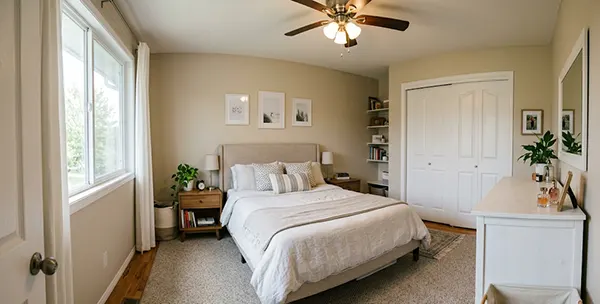
The average bedroom size in the U.S. is 132 square feet. This number translates into 11 feet by 12 feet. That is the average size for several types of bedrooms. You can use this measurement for your master, secondary, guest, kids’, and other types of possible bedroom variations. If you can secure this much space for your bedroom, you are going to have a luxurious and comfortable experience. This much space is enough for meeting all kinds of normal bedroom needs.
Note: While comparing townhouse vs apartment, don’t forget to compare bedroom sizes as well. Sometimes, you don’t even get the standard size of the bedroom in such units. So, be careful right from the beginning.
Standard Bedroom Sizes by Room Type
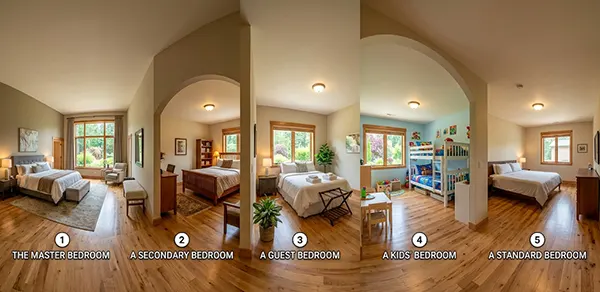
The bedroom standard sizes vary by room type. For example, it is between 200 and 250 sq ft for a master bedroom, while it is 100 to 120 sq ft for a guest bedroom. For more information, refer to the following table.
| Standard Bedroom Sizes | |||
| Room Type | Typical Dimensions | Square Footage | Ideal Bed Size |
| Master bedroom | 14′ x 16′ | 200 – 250 sq ft | King / California king |
| Secondary bedroom | 10′ x 12′ | 120 sq ft | Queen/full |
| Guest bedroom | 10′ x 10′ to 10′ x 12′ | 100 – 120 sq ft | Full / queen |
| Kids’ bedroom | 8′ x 10′ to 10′ x 10′ | 80 – 100 sq ft | Twin/twin XL |
| Standard bedroom | 11′ x 12′ | 132 sq ft | Varies |
Wallinsiders advise: Most people do deep research about bedroom sizes when looking for a new house. Thus, before you truly decide on a housing unit, learn about all the nitty-gritty of how to buy a house in 2026 in advance!
Also read: What is Site Development? Structure & Development Procedure Explained
Minimum Legal & Building Code Bedroom Sizes
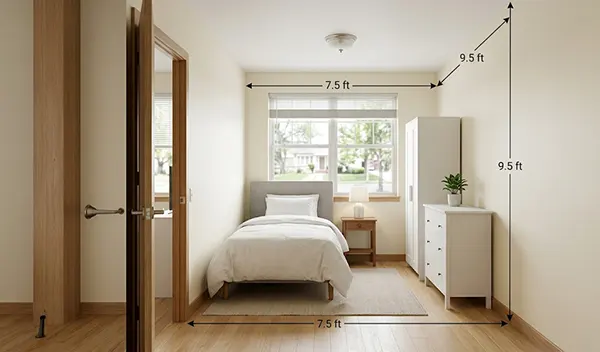
For the standard size of bedroom, most U.S. states and local building codes require a minimum of 70 square feet. This is to be considered along with a minimum dimension of 7 feet in any possible direction.
Furthermore, to be legally counted as a bedroom, the room has to have at least one window for proper ventilation and natural sunlight. And that should follow with emergency egress. Additionally, a closet is also an essential feature in many regions.
| Requirement | Minimum Standard |
| Minimum floor area | 70 sq ft |
| Minimum horizontal dimension | 7 feet |
| Minimum ceiling height | 7 feet (for at least 50% of the room) |
| Window | At least one fully functional |
| Closet | Not required in all jurisdictions |
Do you know? Many rooms with average bedroom sizes don’t fulfil the minimum requirements set by local building codes. Thus, technically, these structures aren’t categorized as bedrooms in property listings. And that negatively impacts resale prices for all types of houses!
How Bedroom Size Affects Home Value
The average bedroom size directly affects home value. The simple rule is that the higher the bedroom size, the higher the property value will be. In other words, rooms that fulfill or exceed the legal criteria often get sold for higher prices than undersized units.
Consider the following table touching upon how bedroom features influence the value of a house.
| Bedroom Features | Impact on House Value |
| Oversized master suite (more than 300 sq ft) | High resale price |
| Standard bedroom size (100 – 200 sq ft) | Average resale value |
| Below minimum bedroom size | Negative impact, as no sensible buyer would like to buy it |
| Additional legal bedrooms | Each addition of a bedroom can increase value by more than 15% in optimal cases. |
Point to note: A room that doesn’t even meet the minimum size requirement of 70 square feet and doesn’t have a window cannot be listed as a bedroom. The listing will have to be reorganized if the issue is raised by any interested party upon closer examination.
However, if your bedroom space doesn’t comply with the limits of the law, you can reconstruct the space with professionals. And make the space law-compliant. Then, it can be easily sold for better prices, and the owner will not have to list it by resorting to illegal means.
Owners of single-family homes must pay attention to these things in advance. Otherwise, the reputation of the property will get spoiled among potential buyers due to misinformation in the listings.
Average Bedroom Size by Country
Let’s now explore the average size of a bedroom by country. The following table includes the United States, the United Kingdom, Australia, Japan, South Korea, and worldwide.
| Countries | Ranges |
| United States | 132 to 350 sq ft |
| United Kingdom | 150 to 250 sq ft |
| Australia | 200 to 300 sq ft |
| Japan | 100 to 200 sq ft |
| South Korea | 100 to 200 sq ft |
| Worldwide | 100 to 250 sq ft |
Wallinsiders insight: It is crucial to learn about average bedroom size in different parts of the world. That is especially crucial if you want to buy houses in more than one country or you already have properties across different countries that you might want to sell in a few years.
Do you know about this limit across Asia? Urban apartments here typically feature bedroom dimensions from 80 to 120 square feet. The minimum requirement is higher than the minimum requirement of 70 square feet in the United States.
How to Know If Your Bedroom is Standard Size
It is very easy to know if a room is a normal bedroom size. All you need to do is measure whether it meets standard dimensions, as mandated by law. Its measurement should be 132 square feet or higher to be a valid bedroom, in compliance with applicable laws.
If you need help with quality assessment, consider hiring a home inspector. However, before you do that, make sure that you go through the home inspection checklist for buyers yourself. That will help you deal with the evaluation process in an informed way.
Point to note: Many small bedrooms create a facade of being spacious and large. But actually, they don’t even meet the minimum space requirement of 70 square feet. This effect is often created by high ceilings, making the room appear bigger.
Another way to know if your bedroom is standard size is by having an in-depth knowledge of applicable laws and limits prescribed in them. Being aware of local rules and regulations is important.
So, if any changes to the law happen, you will know about them in advance.
Also read: How to Paint a Room Yourself: A Step-by-Step Guide for Beginners
What Fits in a Standard-Size Bedroom?
If you have an average bedroom size of 132 square feet, you can fit a queen or full-size bed in this space. Furthermore, if the space is going to be for a kid, bed options include a twin/twin XL. Along with these, small furniture pieces can also be fitted within the space as per the needs and preferences of the child.
Consider the following tips if you want to make the most out of a standard-size bedroom.
- Keep your furniture right-sized or proportional. It will help prevent crowding the floor. Using the right size of bedroom furniture is key to making the space functional and highly mobile. Otherwise, you will have trouble moving in a cramped space.
- Try placing nightstands on both sides of the bed for a symmetrical and compact look. It will provide weight and intensity to your space if that doesn’t feel congested!
- Add soft lighting to create a warm, relaxing mood. It will help you intensify the relaxing mood every night when you return to bed.
Note: If you are considering home renovation, increase your bedroom space if there is the potential. Many times, there is space available, but the owner doesn’t want to touch the years-old construction. If you increase the bedroom space, it will significantly improve the resale value of the house.
Small Bedroom vs. Average vs. Large: Pros, Cons, and Design Tips
Not just the average bedroom size, this section touches upon small and large bedroom pros and cons as well. Each section below follows handy design tips too for decorating your bedroom, whichever type it is.
Small Bedroom Pros and Cons with Design Tips
Have a look at the following advantages and disadvantages of owning a small bedroom.
| Pros | Cons |
| Compact look | Might feel cramped for an adult |
| High affordability | Space issues |
| Least maintenance | Not for owners who believe in the more-is-more philosophy! |
| Ideal for kids | |
| Best for people practising minimalism |
Implement these design tips provided below to make the most of your small bedroom.
- Choose a small, low-lying bed.
- Never use large furniture.
- Use additional items that are low to the ground, but well off as well.
Average Bedroom Pros and Cons with Design Tips
The following table contains the pros and cons of having a standard size bedroom. Consider if it is the right choice for you or your family.
| Pros | Cons |
| Enough for an adult to use | Not ideal for two people |
| Cost effective | Less room for large cupboards |
| Easy to clean and maintain | |
| Easily available |
The best design tips for a standard-sized bedroom are as follows.
- Use a bed not too large and well proportionate to the overall dimensions.
- Don’t add anything to the room except for the bed if you want to have a spacious look.
- Use warm colors to make it most relaxing, or just plain white in case you want to keep it minimal.
- Apply a floral or any other type of wallpaper of your choice on the wall behind the head of the bed. It helps put the entire focus of the room on the bed, making it look larger than its actuality.
Large Bedroom Pros and Cons with Design Tips
These are the upsides and downsides of having a large bedroom in the table below.
| Pros | Cons |
| Room for a double bed | Often expensive |
| Two cupboards can be easily fitted | Very high maintenance cost |
| Vanity space available | Could be too large for a single person |
| Reading space in a corner can be created for sleep hygiene |
Consider the following design tips to decorate your large bedroom.
- Make it sleep-friendly with dim lighting.
- If it is to be used by a single person, use the space smartly by allowing for a reading space, bed area, closet, and a little hobby space! It will then also become sleep-hygiene-friendly. You can read or pursue a relaxing hobby to slow down your mind before bed.
- Place nightstands and a dresser in the room to provide it with a luxurious feel.
- Work with an interior designer for a striking appeal because large bedrooms are easy to decorate stunningly due to the availability of large space.
Also read: Top 10 Best Types of Exterior House Stone For an Elegant Look and Durability
Conclusion
The average bedroom size in the U.S. is 132 square feet. It is the standard dimension that is used in most properties where only limited space is available. Furthermore, talking about the minimum requirement, the floor area should be at least 70 square feet, provided that one dimension is 7 feet. However, for master bedrooms, the area can even reach up to 350 square feet.
FAQs
What is a good size for a master bedroom?
How small can a bedroom legally be?
In most U.S. building codes, the smallest yet legally approved bedroom size is 70 square feet. However, there is a condition that at least one horizontal dimension should be 7 feet. This condition keeps the space completely functional for human use.
Can a king bed fit in a 10’ by 12’ room?
You can fit it there if you want to, but the space is bound to feel cramped. After placing a bed this large in a room sized at 120 square feet, there will only be very little space left on either side. That will automatically make the space unusable for many owners.
Sources:
- Cedreo: The Average Bedroom Size? Here’s What’s Best for Your Designs
- HomeGuide: What is the average bedroom size?
- Clean Home Craft: Average Bedroom Dimensions: Complete Size Guide
Related Post

A Step-By-Step Guide to Building a Retaining Wall
Having a backyard slope or an eroding garden bed can quickly affect the overall appearance and charm of your landscape,…

Guide to Exploring the Best Drywall Alternatives for Your Walls
Drywall often emerges as a highly reliable option when you are looking for the best options for your walls. Drywall…
The Ultimate Kitchen Cabinet Refacing Guide
Transform your kitchen into a luxury space without the cost, mess, or weeks of disruption from a full tear-out remodel.…
What are the Stair Railing Height Requirements? Handrail and Guardrail Height for Safe Design
Have you ever wondered what the stair railing height should be in your home? Stair railing height is the vertical…
Drywall vs. Sheetrock: Types, Benefits, and Installation Cost of Drywall
Have you wondered about the hard material behind the beautiful walls and ceiling? Well, that is drywall or Sheetrock. While…

What is a Barndominium? Benefits, Floor Plans, and Cost Guide for Building a Barndominium…
In recent years, people have been looking for houses with more versatile design, functionality, and cost-effective construction with aesthetic appeal.…